
Last updated November 4, 2026
 Wrought iron
 Wood & steel frame
 Farm & ranch
 Sliding driveway gates
 LiftMaster operators
Free on-site gate assessment - hinges, posts, and your LiftMaster or Nice gate operator checked before anything is quoted
The assessment is free and the quote is the invoice.
Get your free estimateGate Repair Warning Signs: A Murrieta Homeowner’s Reference Guide
A gate that hesitates for two seconds before moving is not ‘just getting old.’ That pause is a classic symptom of a failing start capacitor, a small component that, if ignored, takes the entire motor with it at a much higher repair cost. Most Murrieta homeowners misread these early signals as nuisances instead of diagnostics. This guide translates the specific sounds, movements, and visual cues your gate gives you into the component-level problem they’re signaling, so you can report accurate information and avoid paying for repairs you don’t need.
Quick Answer
The most common gate repair warning signs in Murrieta are grinding or clicking sounds during operation, hesitation before the gate moves, slowing travel speed, reversing mid-cycle, and visible rust streaking or misalignment. A humming sound with no movement usually points to a failed start capacitor or seized motor. Clicking generally means a relay on the control board is failing, and grinding indicates bearing or chain wear in the drive mechanism. Any gate stuck open, sparking, or smelling of burning requires same-day service.
Styles & brands we work with
- Wrought iron
- Wood & steel frame
- Farm & ranch
- Sliding driveway gates
- LiftMaster operators
Table of Contents
- Audio Diagnostics: What Your Gate Is Telling You
- Motion Behavior Warnings: Speed, Reversing, and Stopping Short
- Visual Warning Signs You Can Spot Without Tools
- Access Control Warnings: Keypads, Intercoms, and Loop Detectors
- The 24-Hour Rule: What Needs Same-Day Service
- How We Diagnose: From the Control Board to the Column
- Common Mistakes to Avoid
- When to Call a Professional
Audio Diagnostics: What Your Gate Is Telling You
Your gate speaks before it fails. The sound it makes during operation is the single most reliable early indicator of what’s wearing out. We’ve diagnosed thousands of gates in Murrieta by sound alone before ever removing a cover. Here’s what each specific noise indicates at the component level.
Grinding
Grinding almost always points to the drive mechanism rather than the electronics. In chain-drive gates, it’s typically worn chain rollers or a chain that’s lost proper tension and is dragging across the sprocket teeth. In belt-drive systems, a frayed belt produces a similar but higher-pitched grind. In both cases, the sound happens during movement and stops when the gate stops. Ignoring grinding means the chain or belt eventually jumps the sprocket or snaps, leaving the gate stuck in whatever position it fails in. On a gate repair call, we look at sprocket wear patterns and chain stretch before recommending replacement of any component.
Clicking
A rapid series of clicks when you press the remote or keypad is the sound of a relay trying to engage on the control board. One or two clicks before the gate moves is normal operation. Continuous clicking with no movement means the relay is failing or the board is receiving a command but not sending power to the motor. This is an electronic issue, not a mechanical one. Boards fail for a variety of reasons, including power surges, moisture intrusion, or simply age. The good news is that a clicking relay is diagnosable in minutes with a multimeter, and board-level repair is often more affordable than full replacement when caught early.
Humming Without Movement
A low, steady hum from the operator box with no gate movement is the classic start capacitor failure. The capacitor provides the initial jolt of electricity to get the motor spinning. When it fails, the motor hums but cannot start. You might also notice the gate starts moving if you give it a gentle push, then operates normally until it stops again. Replace the capacitor promptly. A motor forced to attempt starts on a dead capacitor draws excess current and burns out windings, turning a simple parts swap into a full motor replacement.
Intermittent Beeping
Most modern operators, including many Linear, Viking, and Ghost Controls systems, use audible alerts for diagnostic codes. A beeping pattern is not random noise. It’s a code. Count the beeps, note whether they’re short or long, and report that pattern to your technician. Different manufacturers use different codes: some beep three times for a sensor obstruction, others beep continuously for a battery backup failure. The owner’s manual for your operator will have a diagnostic chart, but if the manual is long gone, a technician familiar with your brand can interpret the pattern on site.
Motion Behavior Warnings: Speed, Reversing, and Stopping Short
How your gate moves tells a story about what’s happening inside the operator and along the track. These motion changes happen gradually, which is why many Murrieta homeowners don’t notice them until the gate stops working entirely. But each behavior maps to a specific probable cause.
Slow Travel Speed
A gate that used to open in fifteen seconds and now takes thirty is telling you something. The most common causes are voltage drop to the motor, failing motor windings, or increased mechanical resistance from a binding hinge or roller. In Murrieta’s dry summer heat, motors run hot, and heat accelerates winding insulation breakdown. Dust from the surrounding hills also works into bearing surfaces, increasing friction over time. A technician measures the motor’s current draw under load to distinguish an electrical cause from a mechanical one. The fix for one is completely different from the fix for the other.
Reversing Mid-Cycle
A gate that starts to close, then reverses and reopens, is usually reacting to a safety sensor input. The photo-eye sensors at the base of the gate detect an obstruction, and the operator reverses as designed. If there’s no actual obstruction, the problem is either a misaligned sensor, a dirty sensor lens, or a failing sensor that’s sending false signals. Less commonly, the operator’s close-force setting is set too low, and resistance from a worn wheel or dry track is triggering the reversal. Start by cleaning the sensor lenses with a dry cloth. If that doesn’t fix it, the sensor itself likely needs replacement.
Stopping Short of Fully Open or Closed
Limit switches tell the operator where the gate’s travel ends. When a limit switch wears out or shifts position, the gate stops short of its full open or closed position. You might notice the gate stops a few inches from the post, or doesn’t fully clear the driveway opening. On some models, the limit settings are adjustable; on others, the switch is a replaceable component. Either way, a gate that doesn’t close fully is a security gap and should be corrected. A gate that doesn’t open fully can damage vehicles if it’s a tight fit through the opening.
Visual Warning Signs You Can Spot Without Tools
You don’t need a multimeter to spot half the warning signs a gate gives you. A slow walk around the gate once a month reveals more than most people expect. Here’s what to look for, and what it means.
Rust Streaking Patterns
Rust is never random. The pattern tells you where water is entering and how it travels. Vertical rust streaks running down from a bolt head mean water is getting under the fastener and following the shaft down. Horizontal streaking along a seam means water is pooling in a joint. Rust at the base of a steel post indicates water is wicking up from the concrete footing, which suggests a drainage problem at the foundation. In Murrieta’s climate, we don’t have freeze-thaw cycles, but we do have morning condensation during cooler months, and that moisture finds every unsealed seam. Touch-up paint covers the symptom. Replacing the failed sealant or repairing the drainage fixes the cause.
Paint Bubbling on Steel Posts
Bubbling paint on a steel post means corrosion is active underneath. The rust is expanding and pushing the paint off the metal. By the time you see bubbles, the corrosion has been working for months. Sanding and repainting makes the post look better temporarily, but if the internal corrosion has compromised the post’s structural integrity, the post needs replacement. Tap the bubbled area with a screwdriver handle. A dull thud instead of a metallic ring indicates significant metal loss.
Gap Misalignment
When the gap between the gate and the post changes, something has moved. Hinges wear and settle over time, causing the gate to sag on the latch side. If the gap is wider at the top than the bottom, the hinge pins or hinge plates are worn. If the gap is even but the gate no longer lines up with the latch, the post itself may be shifting. Foundation settlement affects the post footing, and in some Murrieta soils, this is more noticeable after heavy rains. A sagging gate strains the operator every time it runs, spreading the damage from the hinges to the motor over time.
Worn Wheels and Track Damage
On sliding gates, the wheels and track are wear items, no different from tires on a car. Look for flat spots on the wheels, visible wear on the track surface, or debris packed into the track channel. A slide gate that’s louder than it used to be, or that shudders as it travels, is telling you the wheels need attention. Slide gates are heavy, and when a wheel fails, the entire weight of the panel can drop onto the track. That’s when a simple wheel replacement turns into a track repair, and the job gets bigger and more expensive.
Access Control Warnings: Keypads, Intercoms, and Loop Detectors
Access control problems are the most commonly misdiagnosed issues we see. Homeowners dismiss keypad lag or intercom static as ‘signal issues’ when they’re actually symptoms of internal hardware degradation. Here’s how to tell the difference.
Keypad Lag
When you type a code and the gate takes three seconds to respond instead of one, the keypad’s internal membrane or circuit board is degrading. This isn’t a programming issue, and adding a fresh set of batteries rarely fixes it. The lag happens because the keypad’s processor is failing to register keystrokes reliably. Intermittent unresponsiveness follows, then total failure. Keypads exposed to direct sun, which most Murrieta keypads are, degrade faster because UV exposure and heat break down the internal components. Replacing a keypad is a straightforward fix when caught before the unit fails completely.
Intercom Static
Static or crackling on a gate intercom points to a problem in the wiring or the intercom unit itself. In Murrieta, where many homes have long underground wire runs from the gate to the house, the wire’s insulation is the usual culprit. Moisture intrusion at a splice or junction box creates resistance, which shows up as static. Rodents chewing on insulation is another common cause. The static isn’t radio interference. It’s the sound of current fighting through a degraded connection. A technician uses a circuit tester to locate the splice or break and repairs it at the source.
Loop Detector Failures
Loop detectors are the loops of wire buried in the driveway that sense a vehicle’s metal mass and tell the gate to open or stay open. When a loop detector fails, the gate won’t open automatically for exiting vehicles, or it closes on a car that’s still in the path. The detector itself can fail, but the more common culprit is the wire loop breaking underground due to ground movement or concrete work. Diagnosing a loop requires equipment that tests the loop’s inductance, not just the detector box. Some operators, including many DoorKing systems, display loop fault codes on the control board, which gives us a starting point before any digging happens.
The 24-Hour Rule: What Needs Same-Day Service
Not every warning sign is an emergency. In fact, most of the signs above can be scheduled within a week and corrected before they become urgent. But a few conditions demand immediate attention, and knowing the difference saves you money and keeps your property secure.
Same-Day Service Cases
- Gate stuck open in an unsecured position. An open gate removes the security barrier your property relies on. If your gate is a primary security feature for your Murrieta home, this is a same-day call.
- Operator sparking or smoking. This is an electrical fault, and it means something is arcing or overheating inside the operator box. Disconnect power to the operator at the breaker and call immediately. Do not attempt to run the gate before a technician inspects it.
- Burning smell from the operator. A burning smell means insulation or components are overheating, and fire is a real possibility. Kill power and call.
- Gate that won’t close at all. Similar to being stuck open, but with the added complication that the gate may be in the way or leaving the property unsecured overnight.
Schedule Within a Week
- Slow travel speed
- Clicking or humming with the gate still operational
- Rust streaking or paint bubbling
- Keypad lag that’s still functioning
- Minor misalignment that isn’t causing the gate to bind
- Intermittent beeping without other symptoms
When a gate fails on a Saturday, call us and we’ll book you for Sunday. We answer 24/7 and dispatch from 7am to 7pm, Sunday through Friday.
How We Diagnose: From the Control Board to the Column
Durability in gate repair comes from understanding how the whole system works together. A gate isn’t just a motor bolted to a post. It’s the operator, the control board, the sensors, the wiring, the hinges, the wheels, and the structure. A failure in any one of those systems can show up as a symptom in another. That’s why a technician who only knows one brand, or only handles mechanical issues, can misdiagnose the problem.
Our approach to diagnosis starts wide and then narrows. We test the mechanical operation first: the hinges, the wheels, the track, the balance of the panel. Then we move to the electrical system: the control board, the power supply, the sensors and safety devices. Finally, we check the access control equipment: the keypad, the intercom, the loop detectors, and the remote receivers. By working through the system in that order, we locate the true cause rather than treating the symptom. It’s the same method we use whether the operator is a Viking, a Ghost Controls, a Linear, or any other brand we support.
This process matters for one reason: an honest diagnosis saves you money. A gate that’s slow because a hinge is seizing doesn’t need a new motor. A gate that’s reversing because a sensor is dirty doesn’t need a new control board. We’d rather tell you the truth and fix the real problem than sell you a part you don’t need. That’s the difference between a Gate Repair Murrieta diagnosis and a guess.
Common Mistakes to Avoid
- Ignoring a change in sound. A gate that’s suddenly louder, grinding, or clicking is telling you something specific. Sound changes are never harmless. The longer you wait, the more expensive the repair.
- Lubricating without diagnosing. Spraying lubricant on a binding gate feels productive, but it masks the real problem. If a hinge is seizing or a wheel is failing, lubricant buys you a week and hides the symptom from the next technician. Fix the cause first.
- Adjusting force settings to compensate. Turning up the operator’s force setting to overcome resistance isn’t a fix. It’s a workaround that puts additional strain on the motor, the chain, and the structure. The gate will fail harder later.
- Treating every beeping code as a dead battery. Beep codes vary by brand and meaning. A battery-powered operator that beeps is often signaling something specific, not just a low battery. Check the manual or call someone who knows the brand.
- Painting over rust without sealing first. Paint covers rust cosmetically. It doesn’t stop the oxidation underneath. Seal the joint or fastener properly before painting, or the rust will reappear through the fresh paint within months.
- Assuming the gate is a lost cause. Murrieta homeowners sometimes assume a gate that’s stopped working needs full replacement. In our experience, most failures are repairable, often for a fraction of what a new installation costs. Get a diagnosis before making a replacement decision.
When to Call a Professional
Any of the same-day service cases above warrants an immediate call. The gate operator contains high-voltage wiring, and troubleshooting internal electrical components carries a genuine shock hazard. The control board, capacitor, and motor connections are not areas for DIY experimentation. Heavy gate panels can also cause serious injury if they come off their track or fall during a repair attempt.
For the less urgent symptoms, a trained eye catches things a homeowner misses. We find worn hinge pins, seizing wheels, and corroded wiring connections during routine electric gate repair calls that have been causing intermittent symptoms for months. If your gate is doing something it didn’t do last month, that’s a warning sign. Write down the symptom, and call.
Gate Repair Murrieta offers free estimates in Murrieta. Call (855) 817-0665 and describe the symptom you’re seeing or hearing. We answer 24/7. Fast dispatch from 7am to 7pm, Sunday through Friday.
See the difference
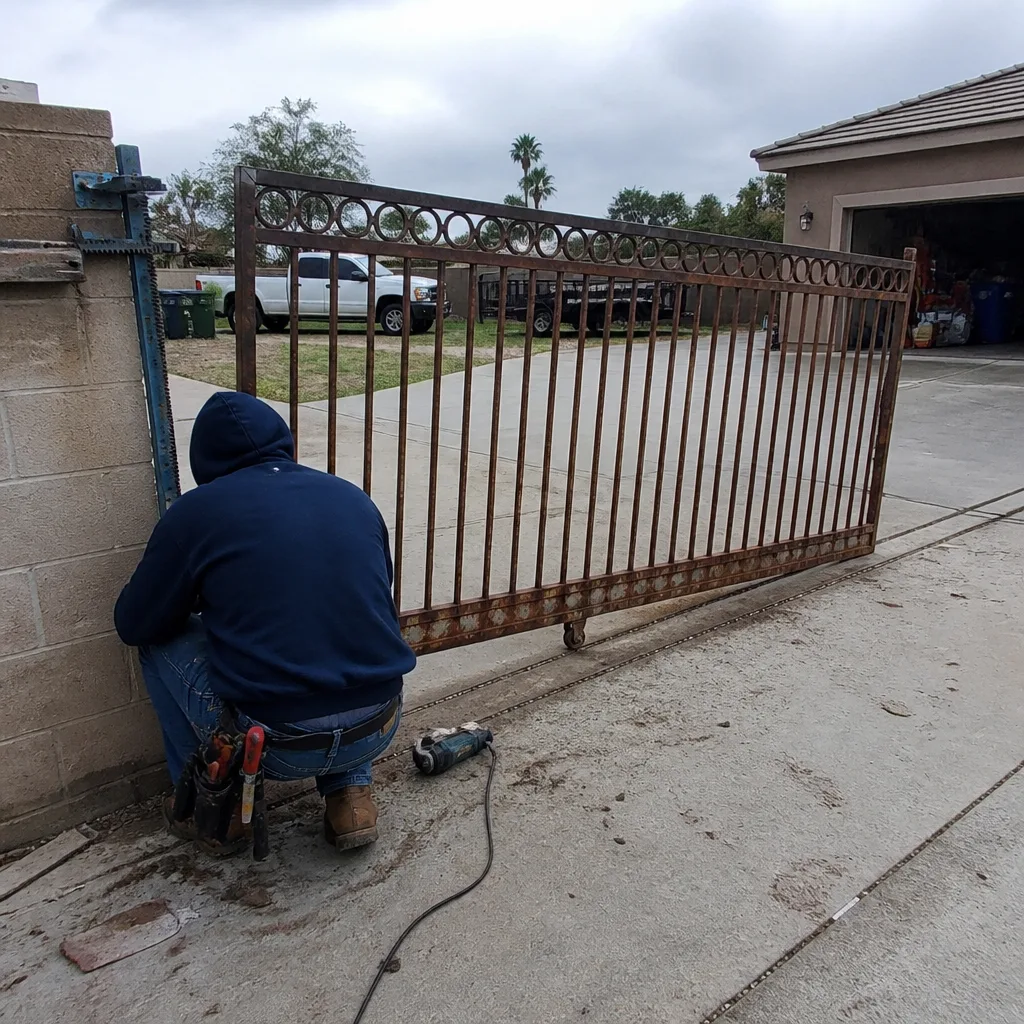 Before
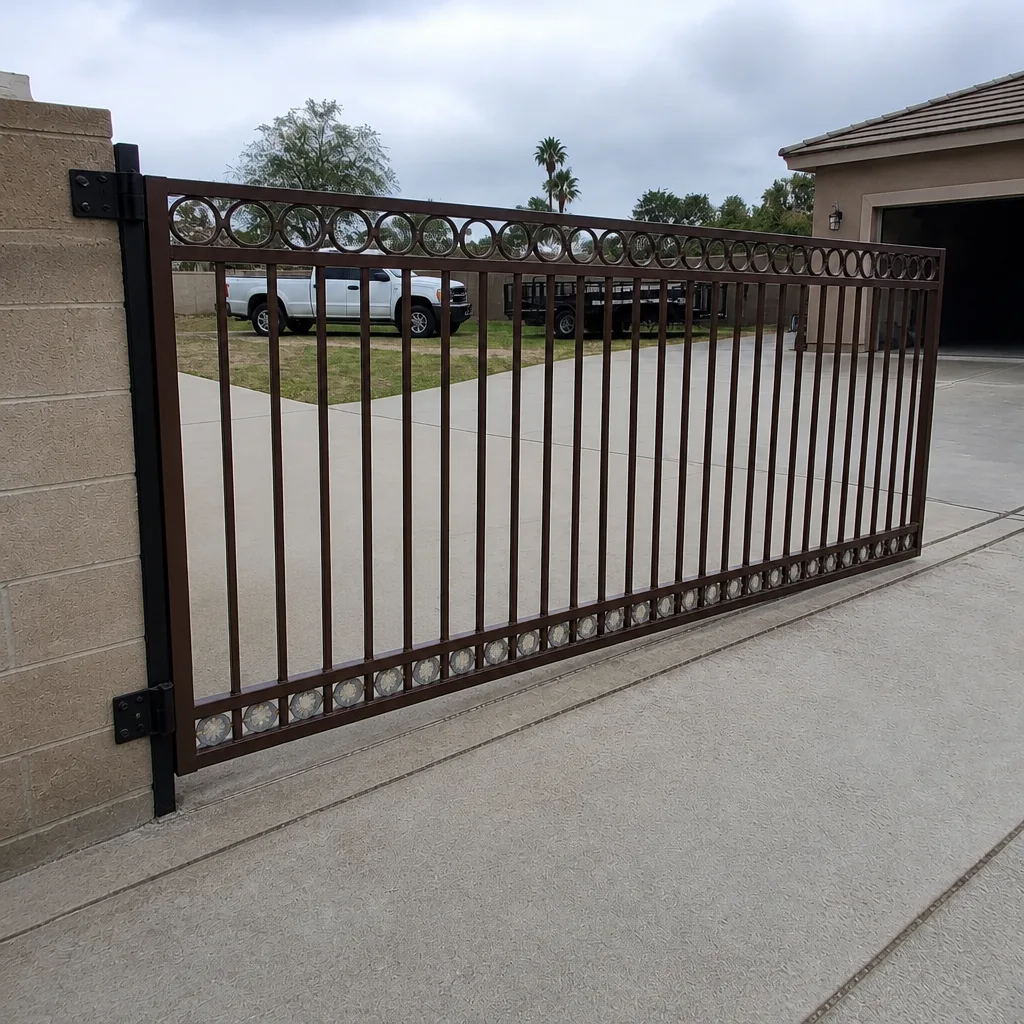 After
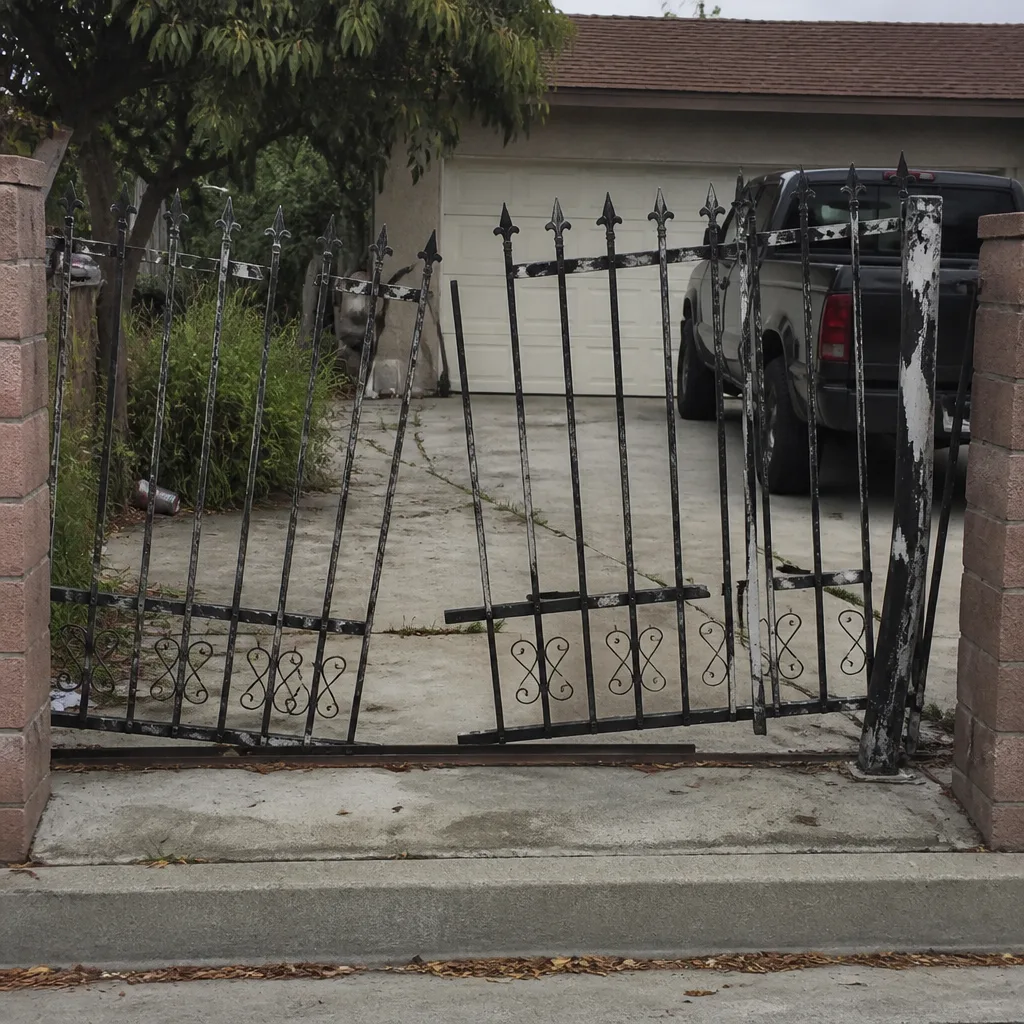 Before
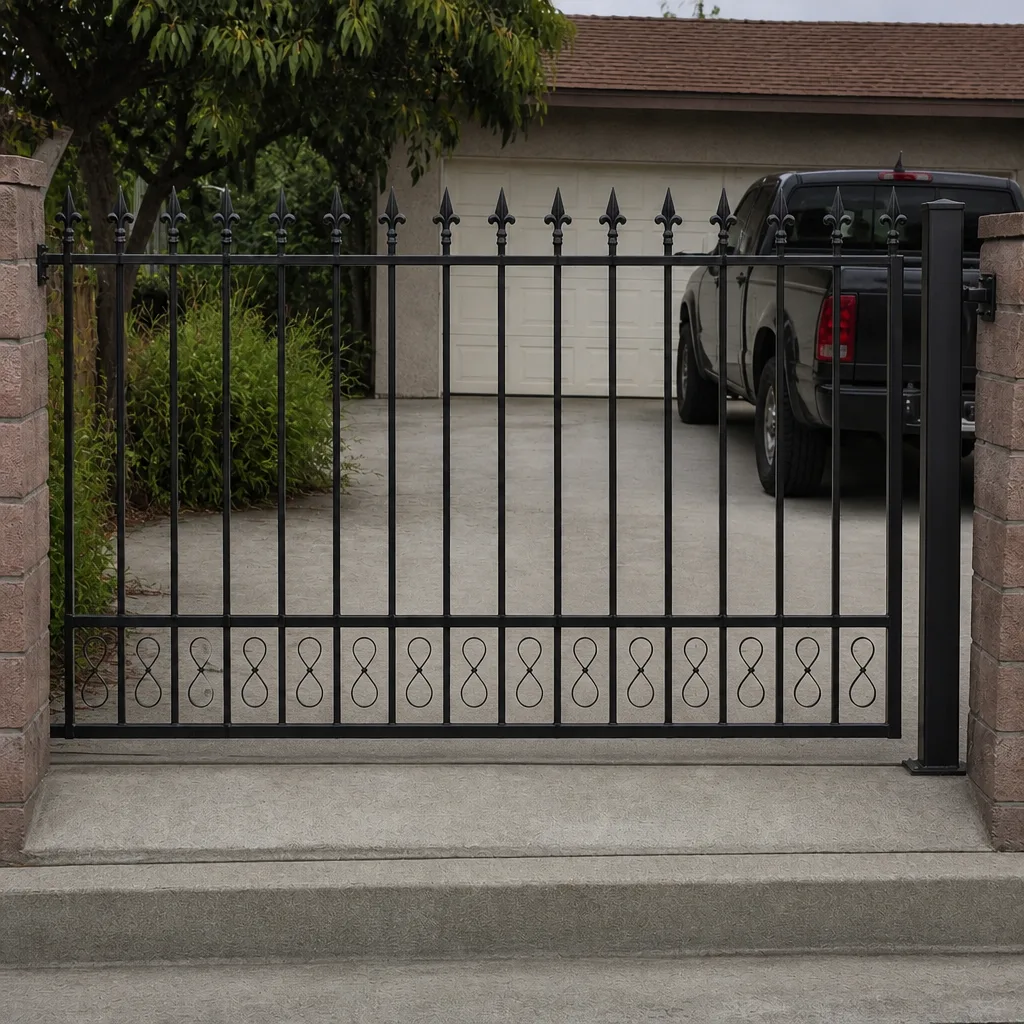 After
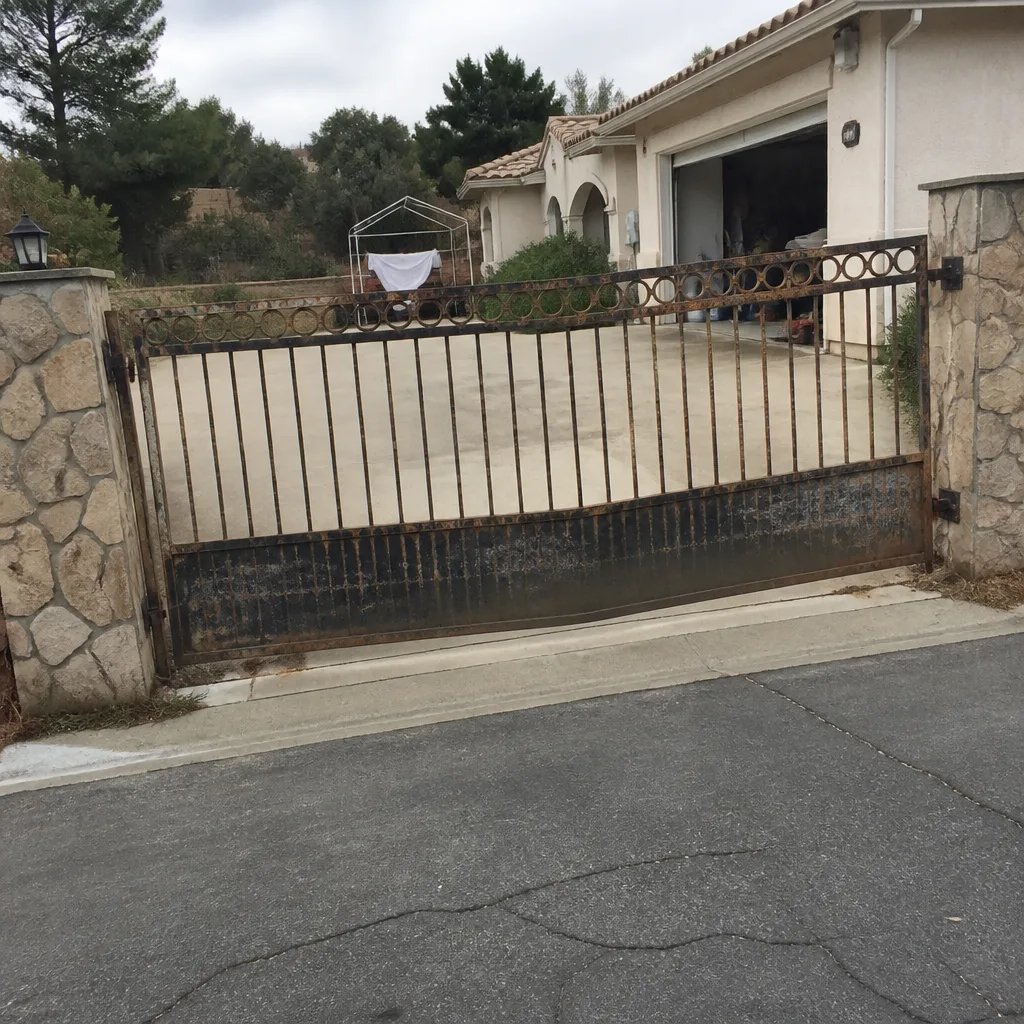 Before
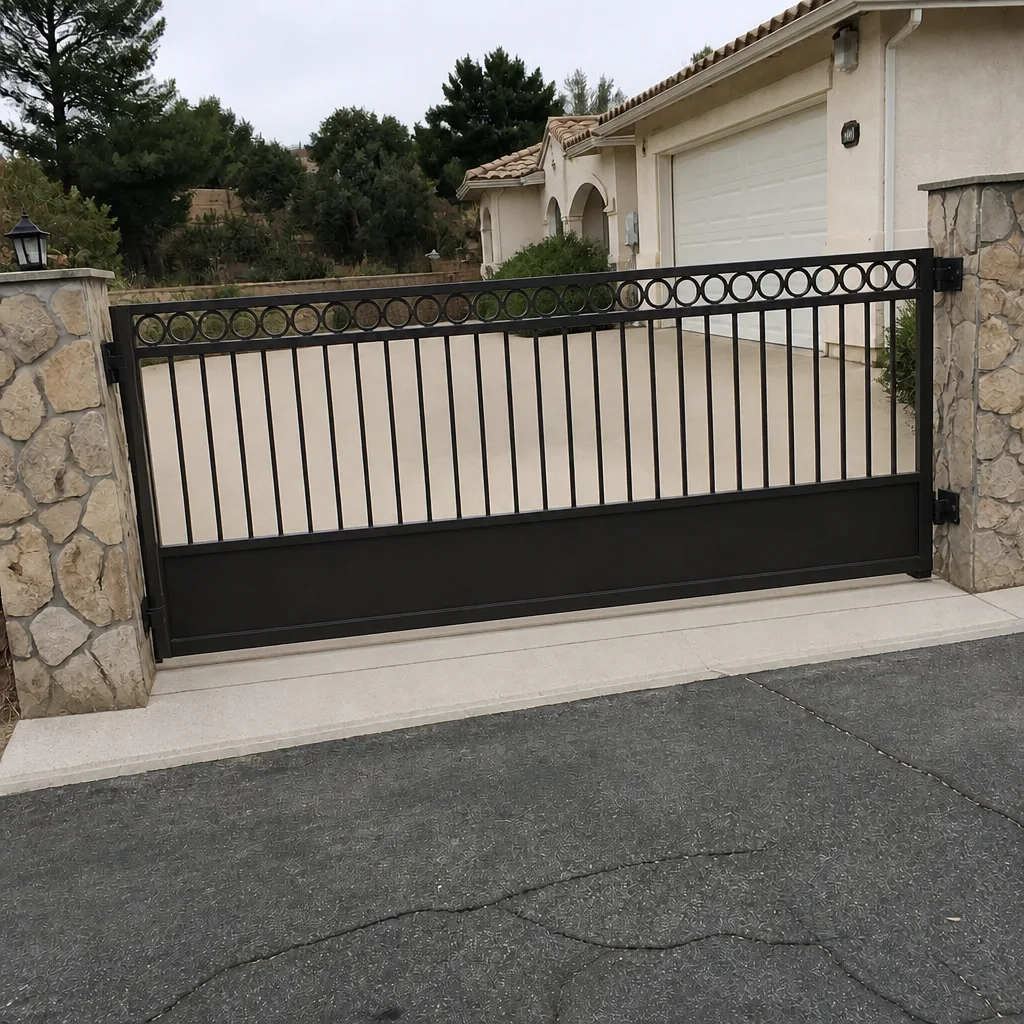 After
Frequently Asked Questions
A humming gate that doesn’t move is almost always a failed start capacitor in the operator. The capacitor provides the starting voltage the motor needs to turn. When it fails, the motor hums but can’t spin. If you give the gate a push and it starts moving, that confirms the capacitor diagnosis. Replace it before the motor burns out.
Reversing mid-cycle with no visible obstruction is usually caused by dirty or misaligned photo-eye safety sensors, or by the close-force setting being too low for current conditions. Clean the sensor lenses first, then check that the gate rolls freely. If the problem persists, the sensor or the operator settings need professional attention.
Mechanical problems make noise: grinding, scraping, or a shuddering motion. Electrical problems tend to manifest as hesitation, no movement with sound, or intermittent operation. A technician confirms the diagnosis with a multimeter test on the motor and control board. That distinction determines which repair path you’re on.
Yes. Same-day service is available for gates that are stuck open, sparking, smoking, or emitting a burning smell. Call (855) 817-0665. We answer 24/7. Fast dispatch from 7am to 7pm, Sunday through Friday. We’re closed Saturday.
Most gates are repairable, and the decision should be based on the condition of the structure, not the age of the operator. A steel gate on solid posts with a failed motor is a strong repair candidate. A gate with corrosion through the posts or a severely sagging panel may warrant a replacement discussion. Get a diagnosis first. The numbers usually favor repair more often than homeowners expect.
We work on a wide range of brands, including LiftMaster, FAAC, BFT, Linear, Viking, Ghost Controls, DoorKing, Elite, and Mighty Mule. Our technicians see both residential and commercial-grade operators regularly, so the odds are strong that we’ve diagnosed a problem like yours before. Call us and describe the symptom.
The Bottom Line
Every gate failure announces itself early. The hum, the click, the grind, the hesitation, the rust streak: each one is a specific diagnostic signal pointing to a particular component. Learning to read those signals means you can report accurate information, get an honest diagnosis, and pay for exactly the repair you need, not a guess. Murrieta homeowners who address warning signs early keep repair costs low and avoid the security gap of a gate that fails without notice. If your gate is making a new sound, moving differently, or showing visible wear, call for a free estimate before the warning becomes a breakdown.
Written by the team at Gate Repair Murrieta, serving Murrieta since 2013.